Causal AI and probabilistic graphical models
Causal models that estimate the effect of interventions and answer what-if questions, built on probabilistic graphical models that combine data with expert knowledge.
What we do
We combine structural causal models with machine learning to answer interventional questions, such as the expected effect of a treatment in patients with given characteristics, and counterfactual questions, such as how the glucose trajectory of a specific patient would have evolved under a different lifestyle, given what has been observed for that patient. Causal graphs are learned from data and refined with expert knowledge, and can be coupled with mechanistic models so that counterfactual predictions remain consistent with physiology. We also use causal inference to emulate clinical trials from real-world data.
Causal models are a class of probabilistic graphical models, which represent the dependencies among variables with a graph. We develop Bayesian networks and hierarchical Bayesian models that share information across related data sets, such as those collected in different hospitals, cohorts or experimental batches, so that each data set benefits from the others while keeping its own characteristics.
Applications. Personalised prevention of type 2 diabetes, treatment decisions in intensive care, effect of fluid therapy on chest X-rays, multi-centre clinical studies.
Methods
Causal AI
- Causal discovery informed by expert knowledge
- Counterfactual inference with mechanistic models
- Target trial emulation from real-world data
- Heterogeneous treatment effect estimation
- Counterfactual generation for medical images
Probabilistic graphical models
- Bayesian networks learned from related data sets
- Hierarchical estimation of the parameters of Bayesian networks
- Mixed-effects models for data from multiple sources
Projects
All projects-
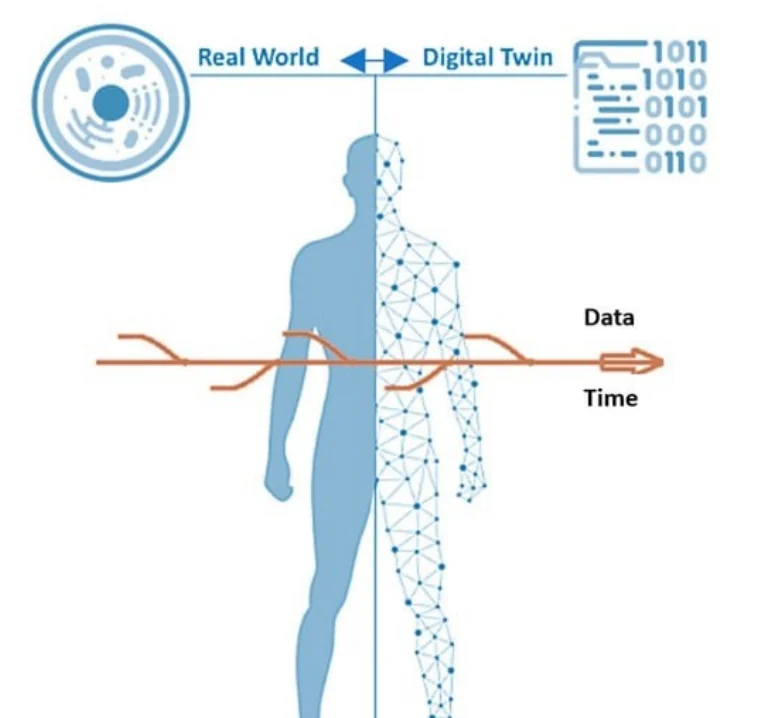
PRAESIIDIUM
Patient digital twins that combine differential equation models of glucose metabolism with clinical and wearable data, to predict individual risk and suggest personalised interventions.
Other projects
-
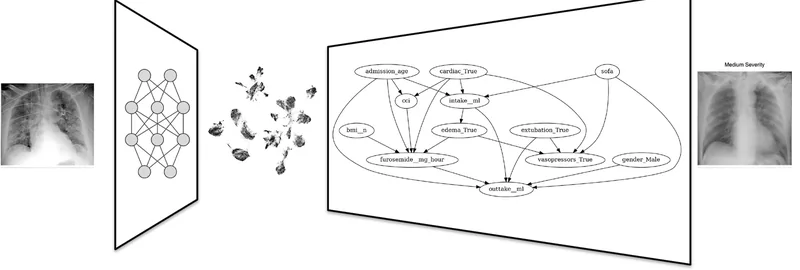
Counterfactual image editing
Generative models with a causal structure that predict how the radiological presentation of pulmonary oedema in intensive care patients would change under a different fluid therapy.
-
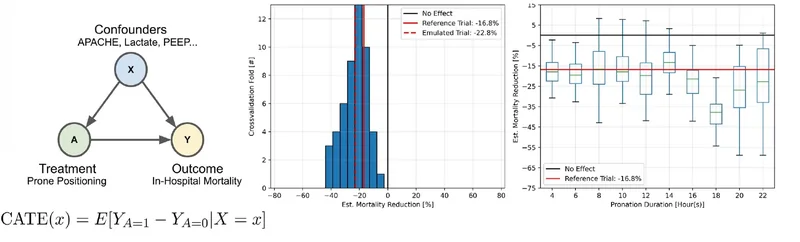
Emulation of clinical trials with real-world data
Target trial emulation on routinely collected intensive care data, to estimate the effect of prone positioning on mortality and how this effect varies across patients.
Earlier projects
-
Statistical learning and inference on big data with probabilistic graphical models
Hierarchical Bayesian estimation of the parameters of Bayesian networks.
Publications
All publications-
Data-Driven and Expert-Informed Causal Discovery for Type 2 Diabetes Risk in Primary Care
Medical Informatics Europe (MIE 2026), Studies in Health Technology and Informatics, 336, 298–302, 2026Code
-
Artificial Intelligence in Medicine (AIME 2025), Springer, Part I, 212–221, 2025Code
-
A Bayesian hierarchical score for structure learning from related data sets
International Journal of Approximate Reasoning, 142, 248–265, 2022
-
Using mixed-effects models to learn Bayesian networks from related data sets
International Conference on Probabilistic Graphical Models (PGM 2022), PMLR, 186, 73–84, 2022
-
Structure learning from related data sets with a hierarchical Bayesian score
International Conference on Probabilistic Graphical Models (PGM 2020), PMLR, 138, 5–16, 2020
-
Hierarchical estimation of parameters in Bayesian networks
Computational Statistics and Data Analysis, 137, 67–91, 2019Code
-
Hierarchical Multinomial-Dirichlet model for the estimation of conditional probability tables
IEEE International Conference on Data Mining (ICDM 2017), 2017Code
-
The Causal Artificial Intelligence Clinician for early hemodynamic management of septic shock in ICU
medRxiv, 2026 Under reviewCode
Software
All software-
Counterfactual inference with differential equation models
Counterfactual inference for ordinary differential equation models, applied to a model of glucose regulation to assess personalised physical activity plans for the prevention of type 2 diabetes.
-
Causal discovery for type 2 diabetes risk
Bootstrap-based causal discovery of a global causal model of type 2 diabetes risk factors from primary care data.
-
Causal AI Clinician
Structural causal models with expert clinical knowledge that estimate the effect of intravenous fluids and vasopressors in the first hours of septic shock, trained on MIMIC and externally validated on eICU, with an interactive dashboard.
-
Hierarchical Bayesian network parameters
Code for the hierarchical estimation of conditional probability tables in Bayesian networks.
Other research lines
-
Physics-informed machine learning
Models that learn from data while respecting the differential equations that describe physical, chemical and physiological processes.
-
Federated learning
Methods and software to train models on data that remain at the institutions that collected them, such as hospitals and research centres.