Counterfactual image editing
Deep learning and causal inference to predict the effect of treatments on chest X-rays
Challenge
In intensive care, fluid therapy is adjusted on the basis of clinical and radiological signs, such as the oedema visible on chest X-rays. Clinicians would benefit from tools that show how the image of an individual patient would look under a different treatment. Standard deep learning models capture statistical associations and cannot answer this type of counterfactual question.
Approach
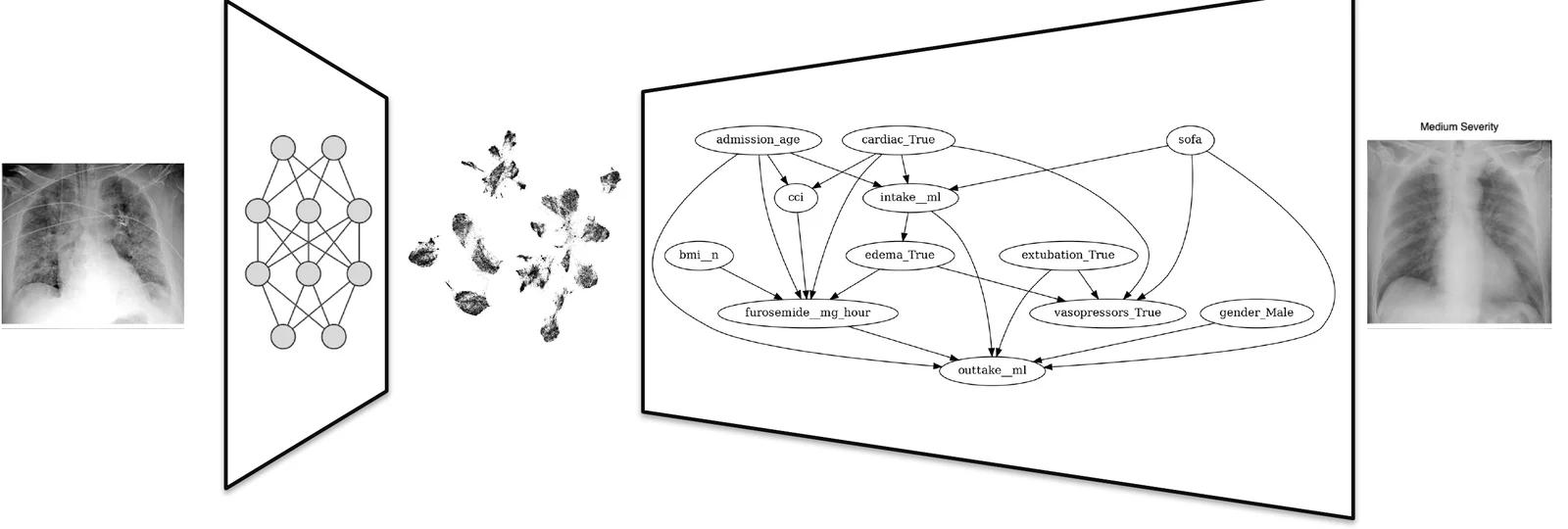
We combine deep generative models of medical images with a causal graph that encodes clinical knowledge about patient characteristics, treatments and outcomes. The encoder infers patient-specific latent factors from the observed image. An intervention on a treatment variable, such as the volume of administered fluids, is propagated through the causal graph, and the decoder generates the counterfactual image of the same patient.
Expected impact
A decision-support tool that allows clinicians to visualise the predicted effect of treatment choices on the individual patient, and a general framework for counterfactual reasoning on complex data such as images.