Federated learning
Methods and software to train models on data that remain at the institutions that collected them, such as hospitals and research centres.
Coordinated by Daniele Malpetti
What we do
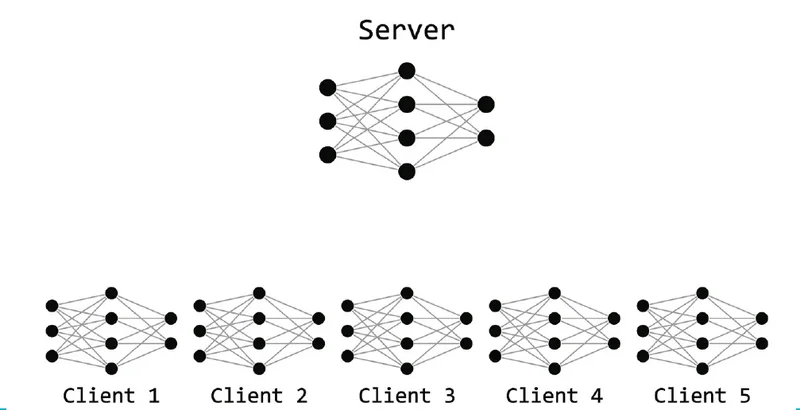
Clinical and biomedical data are often distributed across institutions and cannot be centralised for legal, ethical or practical reasons. We develop federated learning methods and software that train models where the data reside and exchange only model updates or aggregated quantities.
Our work covers secure and flexible federated infrastructures, federated versions of interpretable methods for omics data, and the control of data quality across sites, such as the detection of outliers. These methods are applied in multi-centre clinical projects and are the subject of a dedicated training course at the SIB Swiss Institute of Bioinformatics.
Applications. Antimicrobial resistance across Swiss hospitals, pathway-level analysis of transcriptomic data distributed across institutions.
Methods
- Federated learning frameworks (FLOTTA)
- Federated analytics and data quality control
- Federated interpretable models for omics data
- Privacy-preserving multi-centre prediction models
Projects
All projects-
SPEARHEAD
Machine learning models trained across Swiss hospitals without exchanging patient-level data, to support clinicians in the appropriate use of antibiotics for urinary tract infections.
Other projects
-
NextGen
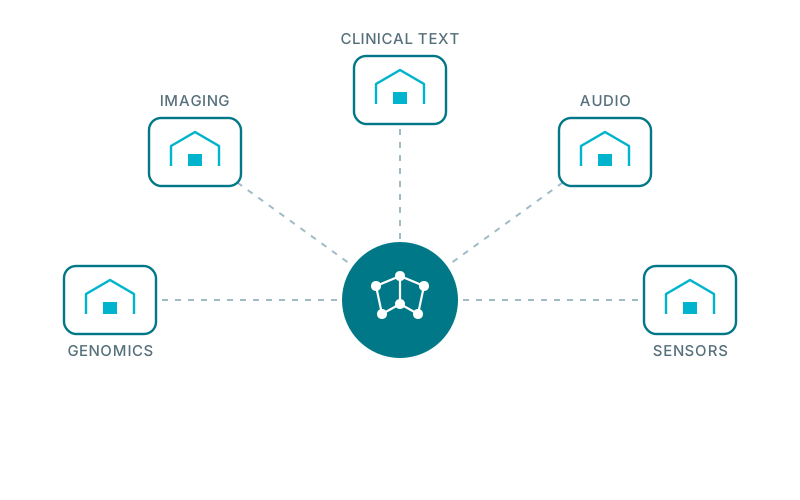
Tools that integrate genomic and other multimodal data into artificial intelligence models for cardiovascular medicine, including federated learning across distributed clinical infrastructures.
Publications
All publications-
FPLIER: Federated Pathway-Level Information Extractor
ACM Conference on Bioinformatics, Computational Biology and Health Informatics (ACM BCB 2026), 2026Code
-
Frontiers in Digital Health, 7, 1644291, 2025Code
-
Global Outlier Detection in a Federated Learning Setting with Isolation Forest
IEEE International Conference on Federated Learning Technologies and Applications (FLTA 2024), 251–258, 2024Preprint
-
Flotta: a Secure and Flexible Spark-inspired Federated Learning Framework
IEEE International Conference on Federated Learning Technologies and Applications (FLTA 2024), 156–161, 2024PreprintCode
Software
All software-
FLOTTA
Secure and flexible federated learning framework, inspired by Apache Spark, for training models across institutions without sharing data.
-
FPLIER
Federated version of PLIER, which extracts pathway-level representations of transcriptomic data distributed across institutions, with a simulation based on the Flower framework.
-
Federated learning in bioinformatics, examples
Example projects with the Flower framework (weakly expressed genes, minor allele frequencies, secure summation) that accompany a review of the technical and legal aspects of federated learning in bioinformatics.
Other research lines
-
Physics-informed machine learning
Models that learn from data while respecting the differential equations that describe physical, chemical and physiological processes.
-
Causal AI and probabilistic graphical models
Causal models that estimate the effect of interventions and answer what-if questions, built on probabilistic graphical models that combine data with expert knowledge.