Emulation of clinical trials with real-world data
Causal inference to estimate treatment effects in intensive care
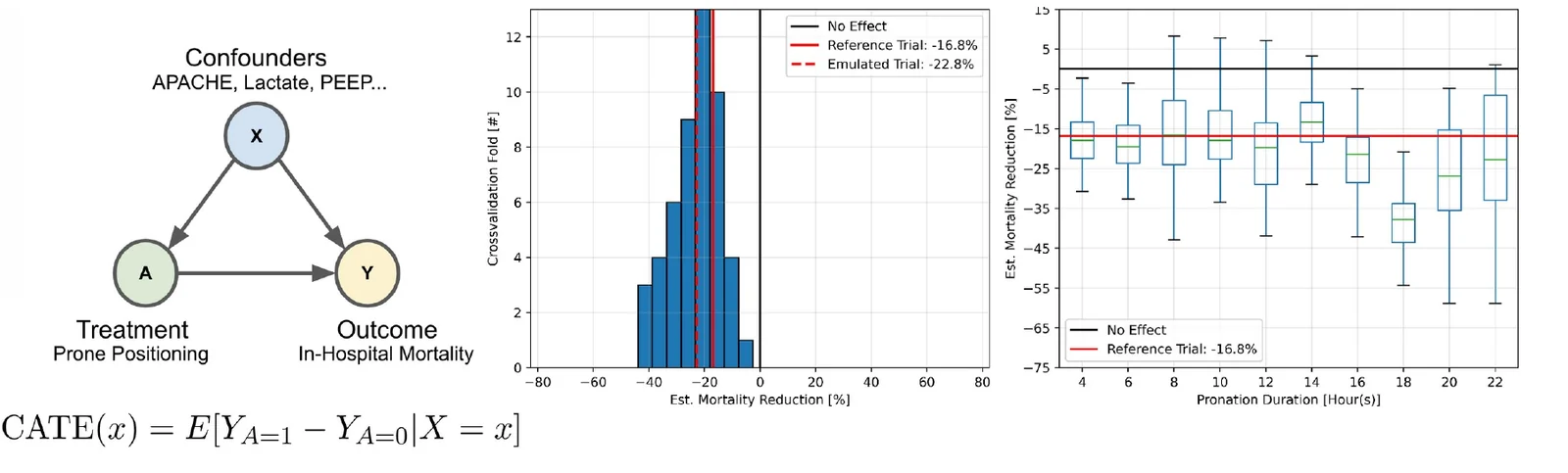
Challenge
Randomised controlled trials provide the strongest evidence on treatment effects, but they are costly, take years to complete and include selected populations. Routinely collected intensive care data are abundant, but a direct analysis is biased by confounding, since the sickest patients are also the most likely to receive certain treatments.
Approach
We emulate a target trial on real-world data with causal inference methods that adjust for measured confounders such as severity scores, lactate and ventilation parameters. The clinical question is whether prone positioning reduces in-hospital mortality in patients with given characteristics. We estimate the effect of pronation, compare it with the result of the original randomised trial, estimate conditional average treatment effects across patient characteristics, and compare treatment strategies that differ in the duration of pronation.
The related publication below applies causal AI to the early haemodynamic management of septic shock.
Recognition
A team of researchers from IDSIA and MeDiTech, together with clinicians and data scientists from EOC and led by Laura Azzimonti, won second place among fifteen teams at the 7th Digital Critical Care Datathon of the European Society of Intensive Care Medicine (ESICM) in 2025.
Publications
-
The Causal Artificial Intelligence Clinician for early hemodynamic management of septic shock in ICU
medRxiv, 2026 Under reviewCode