Physics-informed machine learning
Models that learn from data while respecting the differential equations that describe physical, chemical and physiological processes.
What we do
We embed mechanistic knowledge, expressed as ordinary or partial differential equations, into machine learning models. The resulting models are consistent with known mechanisms, can estimate unobserved states and parameters when these are identifiable, and require fewer observations than purely data-driven models.
Fast surrogates of complex mechanistic models make patient-specific or process-specific simulation possible in real time. The same methods are used for glucose and insulin dynamics in healthcare and for the prediction of the properties of industrial materials.
Applications. Glucose and insulin dynamics in prediabetes and diabetes, disease progression models, characterisation of industrial materials.
Methods
- Physics-informed neural networks
- Hybrid mechanistic and data-driven models
- Inverse problems and parameter estimation
- Surrogate models and digital twins
- Meta-learning across experiments and individuals
- Spatial regression with differential regularisation
Projects
All projects-
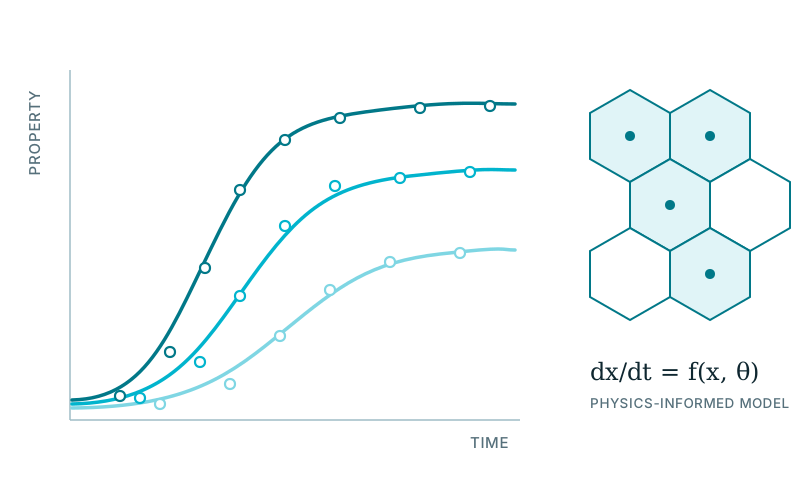
AI for materials characterisation
Physics-informed machine learning models for the prediction of the properties of industrial materials, in a research mandate with an international manufacturing company.
-
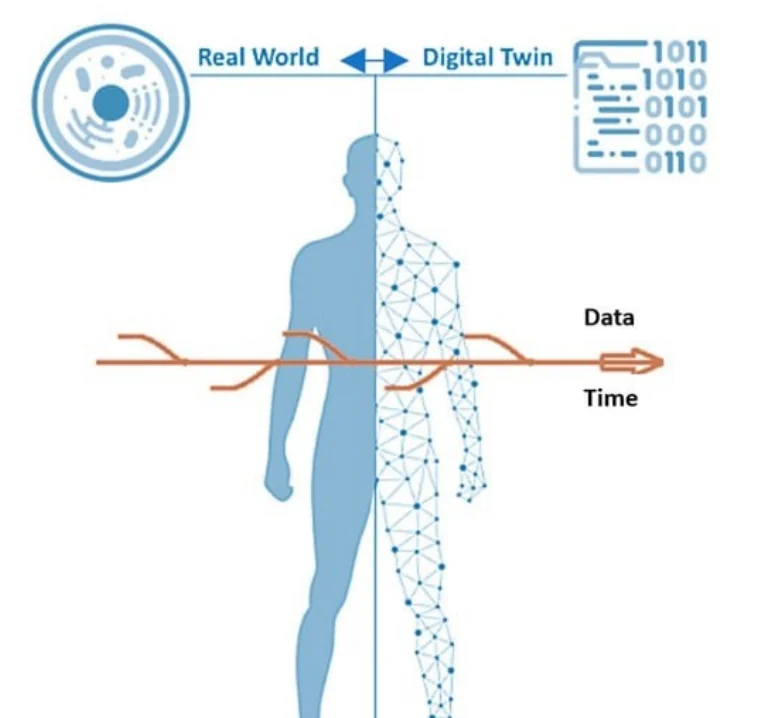
PRAESIIDIUM
Patient digital twins that combine differential equation models of glucose metabolism with clinical and wearable data, to predict individual risk and suggest personalised interventions.
Publications
All publications-
In silico methodologies in computational medicine: From complex disease modeling to virtual clinics
Biophysics Reviews, 7(3), 031304, 2026
-
A reduced model for the long-term effects of physical activity on type 2 diabetes
-
Artificial Intelligence in Medicine (AIME 2025), Springer, Part I, 212–221, 2025Code
-
Physics-Informed Neural Networks for Hidden Insulin Dynamics Estimation from Glucose Data
Artificial Intelligence in Medicine (AIME 2025), Springer, Part II, 283–287, 2025Code
-
A Computationally Efficient Deep Learning-Based Surrogate Model of Prediabetes Progression
IEEE International Conference on Bioinformatics and Biomedicine (BIBM 2024), 6951–6958, 2024Code
-
Modeling spatially dependent functional data via regression with differential regularization
Journal of Multivariate Analysis, 170, 275–295, 2019
-
Blood flow velocity field estimation via spatial regression with PDE penalization
Journal of the American Statistical Association, Theory and Methods, 110(511), 1057–1071, 2015Code
-
Mixed finite elements for spatial regression with PDE penalization
SIAM/ASA Journal on Uncertainty Quantification, 2(1), 305–335, 2014
-
Learning Dynamical Systems from Multiple Sparse Datasets: A Hierarchical Bayesian Modeling Approach
arXiv:2606.24966, 2026 PreprintCode
Software
All software-
Physics-informed neural networks for hidden insulin dynamics
Physics-informed neural networks that estimate insulin dynamics, which are not measured directly, from glucose data.
-
Reduced model of type 2 diabetes progression
Simulation code for a two-scale model of the long-term effects of physical activity on type 2 diabetes and for its reduced (homogenised) version, which allows fast long-term predictions.
-
Surrogate model of prediabetes progression
Deep learning surrogate of a mechanistic model of prediabetes progression, for fast patient-specific simulations. Data and trained model are not included.
-
Hierarchical Bayesian inference for ODE systems
Hierarchical Bayesian estimation of the parameters of ordinary differential equations from multiple sparse data sets, which share information across individuals or experiments.
-
Spatial regression with PDE penalisation
Code for spatial regression with partial differential equation penalisation, used to estimate blood flow velocity fields.
-
Counterfactual inference with differential equation models
Counterfactual inference for ordinary differential equation models, applied to a model of glucose regulation to assess personalised physical activity plans for the prevention of type 2 diabetes.
Other research lines
-
Causal AI and probabilistic graphical models
Causal models that estimate the effect of interventions and answer what-if questions, built on probabilistic graphical models that combine data with expert knowledge.
-
Federated learning
Methods and software to train models on data that remain at the institutions that collected them, such as hospitals and research centres.