Challenge
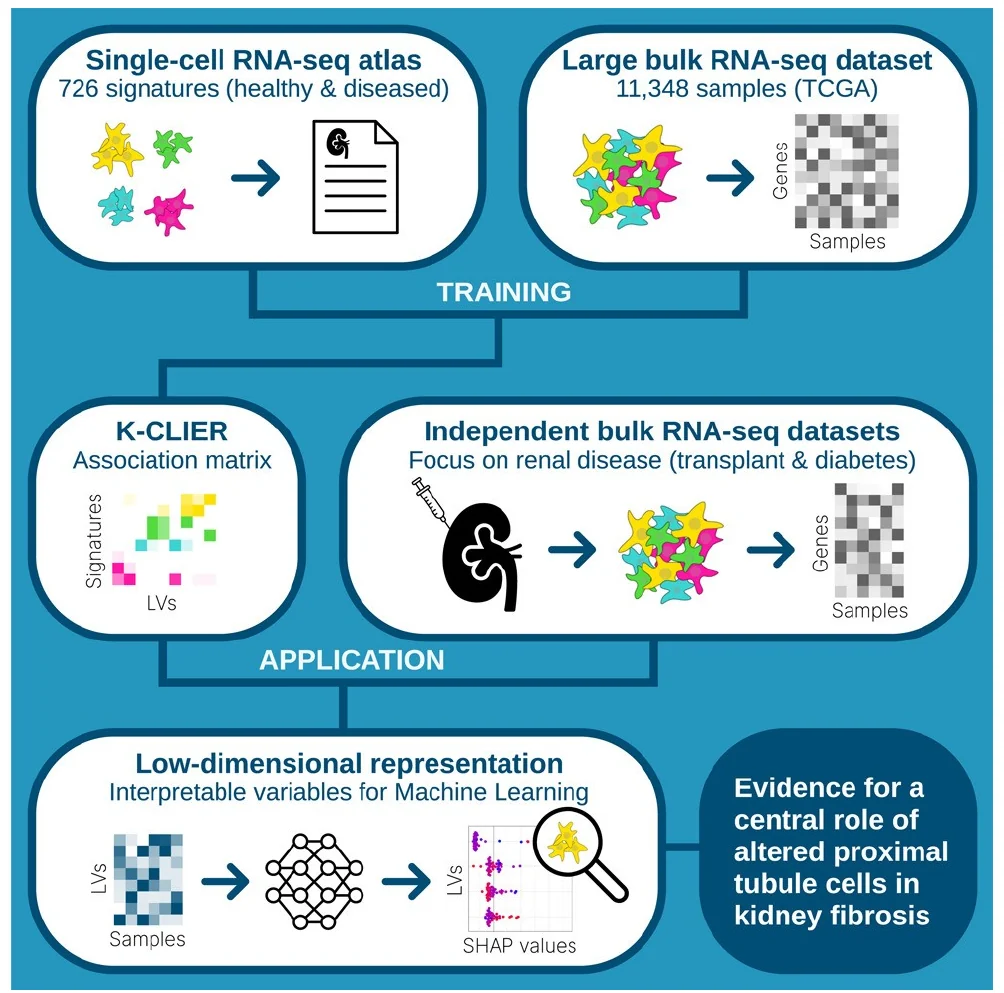
Single-cell transcriptomics has refined our understanding of the cellular composition of tissues and organs. Its use in clinical practice, however, faces major challenges related to tissue processing and data analysis, while bulk transcriptomics is easier to obtain but harder to interpret at the level of cell types and states.
Approach
K-CLIER builds on PLIER, a matrix factorisation method that aligns latent variables with prior gene sets. Using transfer learning, it learns a transformation of bulk gene expression into a low-dimensional representation whose latent variables correspond to cell types and states of a single-cell atlas. Prior biological knowledge, in the form of single-cell signatures, therefore guides the construction of the representation.
Results
We applied the transformation to data from patients with renal diseases. The resulting variables were used to predict clinical outcomes and therapy response in oncological patients and to study rejection in kidney transplantation, and provided evidence for a central role of altered proximal tubule cells in kidney fibrosis. The approach extends to other clinical contexts. A federated version of the underlying method (FPLIER) allows pathway-level analysis of data distributed across institutions.
Publications
-
iScience, 27(3), 109271, 2024
-
STAR Protocols, 6(1), 103670, 2025Code
-
FPLIER: Federated Pathway-Level Information Extractor
ACM Conference on Bioinformatics, Computational Biology and Health Informatics (ACM BCB 2026), 2026Code
Software
-
K-CLIER protocol
Step-by-step protocol, with R code and test data, for interpretable, single-cell-informed deconvolution of bulk RNA-seq data.
-
FPLIER
Federated version of PLIER, which extracts pathway-level representations of transcriptomic data distributed across institutions, with a simulation based on the Flower framework.